Form I-9 Compliance: ICE Rewrites the I-9 Rules - What Employers Need to Do Before a Notice of Inspection Arrives
Julie Solis-Alvarado | Mariah L. Sukalski
April 17, 2026 | Immigration | Labor and Employment | Press Release
If your company has not conducted a formal internal Form I-9 audit recently, it may be time to do so. On March 16, 2026, U.S. Immigration and Customs Enforcement (ICE) quietly updated its Form I-9 Inspection Fact Sheet, providing no Federal Register notice, no proposed rulemaking, and no public announcement. With a single document, ICE fundamentally changed the rules governing how I-9 errors are treated when an employer faces an audit.
Since I-9 guidance had not been meaningfully updated in over a decade, we believe this update is a precursor to significantly heightened I-9 audit activity. With the updated Form I-9 Inspection Fact Sheet, ICE now has the framework to increase audits and penalties.
What Changed: The End of the "Technical Violation" Cure Window
For nearly 30 years, I-9 paperwork errors fell into two categories:
- Substantive violations: immediately fineable, no opportunity to correct.
- Technical/procedural violations: employer received 10 business days to fix the error before any fine could be assessed.
The 10 business day cure window was a meaningful protection which many employers relied on it, often without even realizing it, during government inspections. The March 2026 Fact Sheet eliminates that protection for more than ten categories of errors that were previously considered technical.
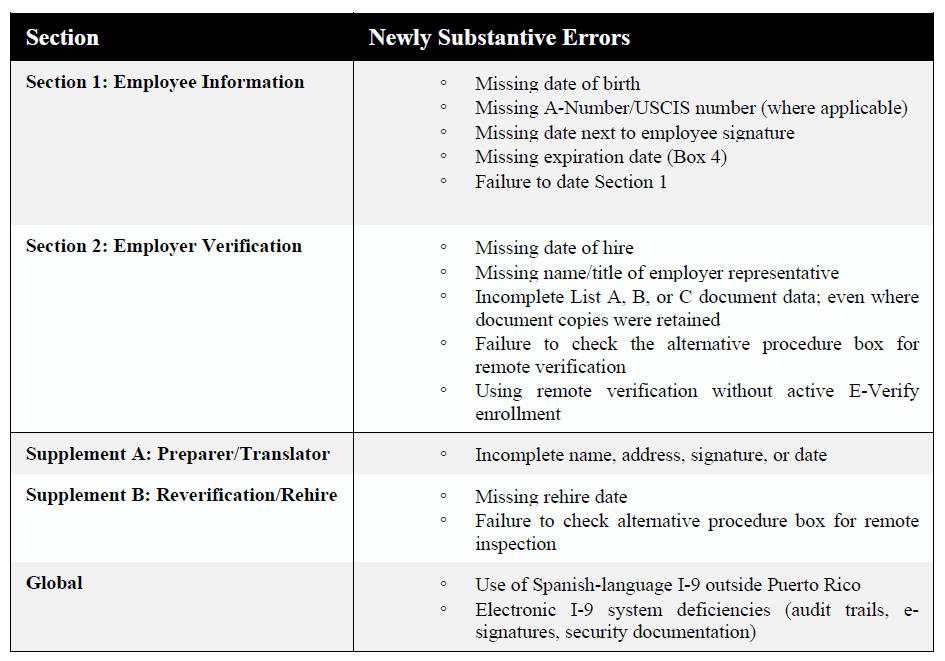
Errors Now Reclassified as Substantive (No Cure Period)
The following errors, previously curable within 10 business days, are now immediately fineable the moment ICE opens an audit:
The Document Copy Safe Harbor Is Gone
Under prior guidance, retaining a legible copy of an employee’s identity or work authorization document could cure missing Section 2 data. That safe harbor has been eliminated. Missing or incorrect List A, B, or C entries in Section 2 are now substantive violations regardless of whether copies of the corresponding documents are on file.
If your organization has relied on document retention as a backstop for incomplete I-9 forms, that practice no longer protects you.
The Financial Stakes
Per-form civil penalties currently range from $288 to $2,861 (inflation-adjusted, Federal Register, January 2, 2025). The math is sobering. An example is provided below on potential penalties an employer could face if each I-9 had just ONE error. These figures assume only a single error per Form I-9. In practice, penalties compound quickly. Each individual error on each individual form carries its own fine, meaning an employer with multiple deficiencies per form faces exposure that can multiply well beyond the estimates listed below:
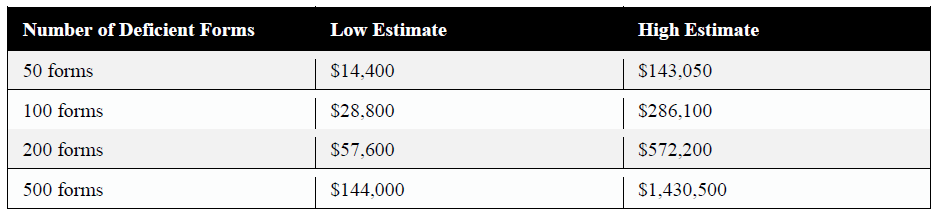 The above figures do not account for repeated violations, “knowingly hire” or “continuing to employ” violations, which carry substantially higher penalties, or for the reputational and operational consequences of a government inspection.
Timing Matters: Acting Before a Notice of Inspection
Given the new guidance, Pre-inspection remediation is the only remaining tool for avoiding penalty exposure on reclassified errors. Once ICE issues a Notice of Inspection (NOI), correcting errors will not reduce your liability. The window to fix these issues without penalty closes the moment an NOI arrives.
There are three additional reasons why acting now is critical:
- Violations are continuing. A deficient Form I-9 for a current employee is a live, ongoing violation. The five-year statute of limitations does not begin to run until the form is corrected or the retention obligation expires. Every day of inaction is a day the violation continues.
- Incomplete audits create their own risk. An employer that identifies violations and fails to correct them are at risk. Documentation of known, uncorrected deficiencies can support an inference of bad faith during enforcement proceedings.
- ICE enforcement is accelerating. The fact that I-9 guidance had not been updated in over a decade and was suddenly revised without notice or rulemaking signals that enforcement activity is coming. Employers who wait for an NOI to prompt action will find that the cure period they expected no longer exists.
What Your Organization Should Do Now
- Commission an immediate internal I-9 audit and re-examine any prior audit findings under the new framework.
- Correct all reclassified errors before any Notice of Inspection is served.
- Stop relying on document copies to cure Section 2 gaps. Ensure Section 2 is properly completed at the time of initial onboarding.
- Verify that electronic I-9 systems meet DHS standards including audit trails, e-signature protocols, and security documentation.
- Confirm proper use of alternative and remote verification procedures, and verify active E-Verify enrollment where required.
- Retrain all personnel responsible for Form I-9 completion on the updated requirements.
- Engage qualified immigration counsel now before any government contact so you have a plan and a direct line ready if an NOI, administrative site visit, or other agency contact occurs.
How We Can Help
Our immigration team conducts comprehensive internal Form I-9 audits and provides virtual or in-person employee training on Form I-9 compliance. We work confidentially, identify and correct deficiencies before any government contact, and help your team build practices that prevent violations going forward.
Contact Attorney Julie Solis-Alvarado or any of our other Immigration attorneys today to schedule a confidential consultation.
This alert is provided for informational purposes only and does not constitute legal advice. Employers should consult qualified immigration counsel regarding their specific circumstances.